The company is becoming software.
For a century, building a company meant assembling people. The next one means composing software that does the work, under your direction, in the open, and accountable to you.
The company is becoming software
For a century, to build a company was to assemble people. You hired, you trained, you coordinated, and the company was the sum of everyone in it. The work and the workforce were the same thing. That era is ending.
The work that filled those roles is turning into software you can direct. Not a tool that sits beside the company, but the company itself: its departments, its memory, its daily work, expressed as systems you operate rather than teams you manage.
This is our account of that shift, and of the product we built to meet it honestly. We are not interested in a magic box that hides what it does. We are interested in leverage you can see, correct, and stop. Here is what we believe, and what we built to back it up.
One person, a whole company
It used to take a team to run a company. Marketing needed marketers. Support needed a desk. Operations needed coordinators who kept the parts moving. Each function was a group of people, a payroll line, a hiring cycle measured in months.
That constraint is dissolving. A single founder can stand up a Marketing department, a Sales department, a Support department, each one an agent workspace with its own memory, its own sandbox, and its own running tasks, and operate all of them from one screen.
You add capability by composing a department, not by opening a req.
The promise is not a company that runs itself while you sleep. The promise is leverage: the ability to direct many specialized workstreams at once, the way a good operator directs a team, without needing the team. The ceiling on what one person can build moves, and it moves a long way.
The end of the org chart
The org chart was always a map of people. Boxes were chairs and lines were reporting. To grow, you added boxes, and adding boxes meant recruiting, onboarding, and the slow work of turning strangers into colleagues who shared context.
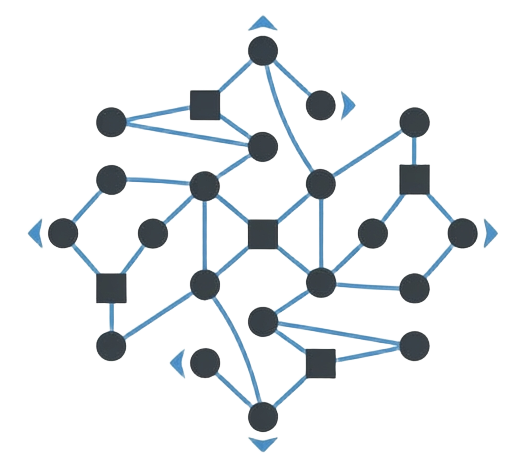
When departments are software, the chart becomes something else: an interface. You grow the company by composing a new department, and you can watch every one of them work at a glance, in the same place, in real time.
Headcount stops being the unit of ambition. The unit becomes the workspace: a charter, a set of roles, a tool allowlist, a memory. You scale by description, not by hiring. The distance between an idea and an operating function collapses from a quarter to an afternoon.
AI-native by default
Most software bolted AI on as a feature: a chat box in the corner, a summary button, an assistant you have to invite into the work. The companies being built now start from the other end. Agents are the default workforce. Humans set direction, taste, and judgment.
Every Foundworks department ships with a charter, a set of agent roles, and a tool allowlist. Agents plan, execute inside isolated sandboxes, write their results to a shared memory, and ask each other for what they need through an explicit, logged protocol. The departments are not islands; they share company-wide context, so nobody drifts off-script.
The human is not in the loop for every keystroke. The human is in the loop for the decisions that carry consequences. That is what AI-native actually means: not an assistant beside the company, but the company's operating substrate.
A company you can read
Autonomy without visibility is just a black box you are asked to trust on faith. We think that is exactly backwards. The more a system does on its own, the more legible and controllable it has to be. Capability and accountability are not a trade-off here; they rise together, by design.
So we built the trust in, not on. Not a word bolted to the marketing, but a set of mechanisms you can inspect, edit, and switch off. Six of them, not six promises:
Glass-box memory
Your company's knowledge lives as Markdown files in a folder tree you can open, edit, and lock. It is not an opaque vector store. If an agent learns something wrong, you fix the file.
Approval gates
Before an agent sends an email or takes any outward action, it asks. You approve it, or you write a standing rule that approves it for you. Agents cannot act around you.
Recoverable by default
Deletes go to a 30-day trash, not the void. A mistake is something you undo, not a catastrophe you discover later.
Every action on the record
User actions are written to an audit log. You can always answer the only question that matters after the fact: who did what, and when.
Cost you can see and cap
Every model call is metered to the cent and rolls up per business. No surprise bills. Budgets degrade gracefully instead of running away.
Hard tenant walls
Each business is a strict boundary: separate memory, separate sandboxes, separate meter. Nothing leaks from one to another.
These are not assurances you have to take our word for. They are properties of the system, the kind you can verify yourself, on your own data, on any given day.
Autonomy you can pause
There is a version of automation that asks you to step back and let it run. We are building the opposite: automation that keeps you able to step in. Three verbs hold the whole philosophy together.
Read. Every department's knowledge lives as plain files you can open. If an agent learned something wrong, you do not file a ticket and wait. You fix the file, and the agent works from your correction the next time it runs.
Correct. Nothing outward happens without your say. An agent that wants to send an email or move money asks first, or follows a standing rule you wrote on purpose. Mistakes go to a recoverable trash, not the void, and undo is a first-class feature rather than an apology.
Pause. You can stop a department mid-stride. The work waits, the state persists, and nothing is lost. Control is not a panic button bolted to the side of the product. It is the default posture of the whole system.
The platforms people trust with real operations will be the ones you can read, correct, and pause, not the ones that ask for faith.
What humans are for
A reasonable worry about all of this is that it leaves nothing for people to do. We think it leaves exactly the part that was always theirs, and strips away the part that never should have been.
When the mechanical work is handled, what remains is direction, judgment, taste, and the calls that carry consequences. Which markets to enter. Which customers to keep. Which line not to cross. What the company is actually for, and what it refuses to become.
Humans move up the stack. The founder stops being the bottleneck on execution and becomes what they were trying to be all along: the person who decides where the whole thing is going, and who answers for it.
The next decade
We will be wrong about some of this. Manifestos always are. But here is the shape of the bet we are willing to make in public.
Companies will be operated, not staffed.
The unit of work shifts from the hire to the workspace. You add capability by composing a department, not by opening a req.
The org chart becomes an interface.
You grow a company by adding departments rather than headcount, and you can see every one of them working at a glance.
Transparency wins.
The platforms people trust with real operations will be the ones you can read, correct, and pause, not the ones that ask for faith.
Humans move up the stack.
What is left for people is the work that was always theirs: direction, judgment, taste, and the calls that carry consequences.
Foundworks is our wager on that future, built so a founder today can operate like a company of fifty and still know exactly what their company is doing, line by line, decision by decision.
Build in the open
Start with one department. Give it a charter and watch it work. Read what it writes. Correct what it gets wrong. Add the next department when you are ready, and the one after that when you are not yet sure but curious.
A company that runs itself does not have to be a company you cannot see into. That is the whole idea. Build one that runs itself, in the open.
Build a company that runs itself, in the open.
Start with one department. Watch it work. Add the next when you are ready.
Start free